Java Type Casting: Convert Data Types with Examples
Learn Java type casting including widening (implicit) and narrowing (explicit) conversions. Master int to double conversion, safe type casting, and automatic conversions with practical examples.
1. The Integer Division Trap
Imagine you want to calculate the average of 5 and 2. You might write:
double average = 5 / 2;
System.out.println(average);
You might expect 2.5, right? But Java prints:
2.0
Why?
Because 5 and 2 are both integers (int). When Java divides two integers, it truncates the decimal part—no rounding, no guessing—just chops it off. So:
5 / 2 → 2
Then it stores that integer 2 into a double variable, turning it into 2.0.
Solution: Use Type Casting to tell Java to treat one number as a decimal.
2. Implicit Casting (The “Widening” Safe Zone)
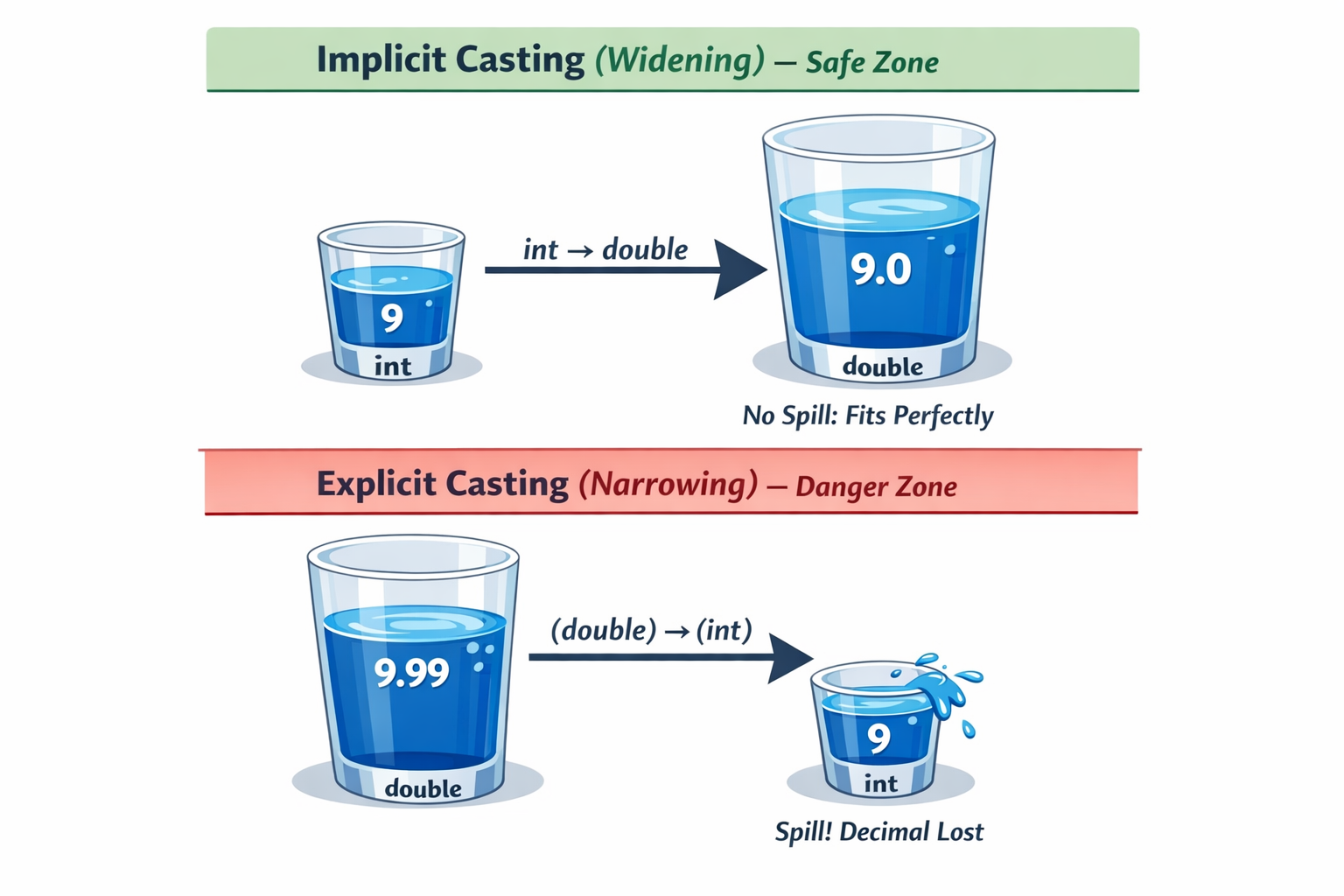
Think of data types as cups:
int→ medium cupdouble→ large cup
Pouring a medium cup of water into a large cup is safe: nothing spills.
Java does this automatically when converting a smaller type to a larger type:
int myInt = 9;
// Automatically converted from int → double
double myDouble = myInt;

System.out.println(myDouble); // 9.0
✅ No data is lost. This is called implicit casting.
3. Explicit Casting (The “Narrowing” Danger Zone)
What if you try to pour a large cup (double) into a medium cup (int)?
Some water (the decimal part) will spill. Java won’t do this automatically because it can lose data. You have to force it using explicit casting:
double exactPrice = 9.99;

// Force double → int
int roundedPrice = (int) exactPrice;

System.out.println(roundedPrice); // 9
Notice that .99 is completely gone.
⚠️ This is called explicit casting, and it’s your responsibility to be careful.
4. Fixing the Division Trap
We can combine casting with division to get the correct average:
double average = (double) 5 / 2;
System.out.println(average); // 2.5
By casting one number to double before dividing, Java performs decimal division instead of integer division.
💡 Tip: You only need to cast one operand, not both.
✅ Quick Summary
| Concept | Example | Output | Notes |
|---|---|---|---|
| Integer Division Trap | 5 / 2 |
2 | Truncates decimals |
| Implicit Casting | int → double |
9.0 | Safe widening |
| Explicit Casting | double → int |
9 | Narrowing, may lose data |
| Fix Division Trap | (double)5 / 2 |
2.5 | Cast one operand to perform decimal division |