DRY Principle in Software Development: Avoid Code Repetition
Master the DRY (Don't Repeat Yourself) principle to write maintainable, efficient code. Learn how to eliminate code duplication, improve readability, and reduce technical debt with practical examples.
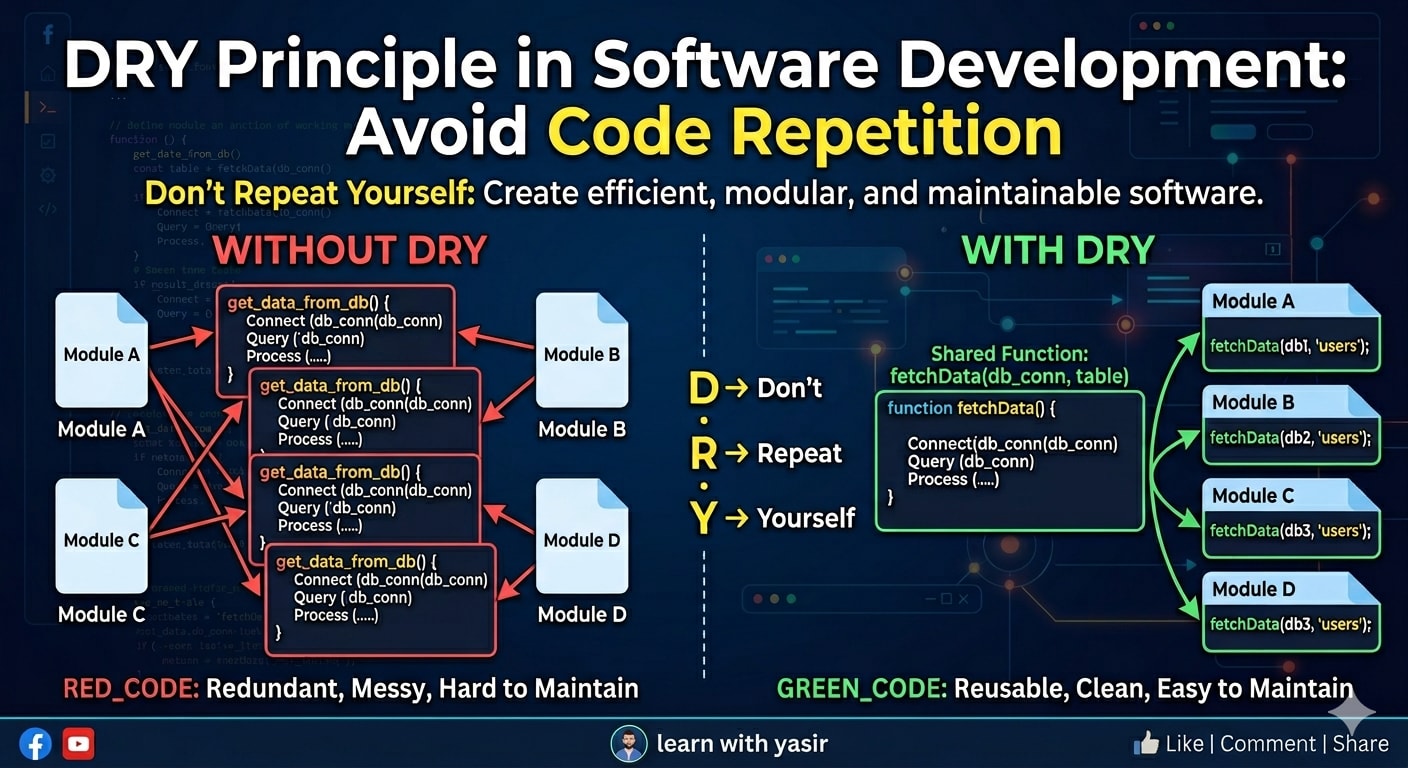
The DRY (Don’t Repeat Yourself) principle is a core philosophy in software development aimed at reducing the repetition of information. It was first formulated by Andy Hunt and Dave Thomas in their book The Pragmatic Programmer.
At its heart, the principle states:
“Every piece of knowledge must have a single, unambiguous, authoritative representation within a system.”
Why DRY Matters
When you have the same logic or data in multiple places, you create a maintenance nightmare. If that logic needs to change, you must remember to update it in every single location. Missing just one spot leads to bugs, inconsistencies, and technical debt.
Key Benefits
- Maintainability: You only have one place to fix a bug or update a feature.
- Readability: Code becomes more concise and easier to follow.
- Testing: It is much simpler to write a unit test for one centralized function than for five identical snippets scattered across a project.
How to Apply It
DRY isn’t just about “copy-pasting” code; it applies to logic, documentation, and even database schemas.
| Method | Description |
|---|---|
| Functions/Methods | Move repeated logic into a single function that can be called whenever needed. |
| Constants | Instead of typing the number 3.14 everywhere, define a variable PI = 3.14. |
| Inheritance/Mixins | Share common behavior across different classes in Object-Oriented Programming. |
| Modules/Libraries | Package common utilities so they can be shared across different projects. |
The “Rule of Three” (When to be Careful)
While DRY is powerful, over-applying it can lead to over-engineering. If you try to make code DRY too early, you might create complex abstractions that are harder to manage than the original repetition.
Many developers follow the Rule of Three:
- The first time you do something, you just do it.
- The second time you do something similar, you might wince at the duplication, but you copy it anyway.
- The third time you do something similar, you refactor it into a reusable component.
Pro Tip: Sometimes, “duplication is cheaper than the wrong abstraction.” If two pieces of code look the same but change for different reasons, they might not actually be “the same knowledge” and shouldn’t be DRYed.
Explore More Topics
📘 Learn Python
Tutorials, Roadmaps, Bootcamps & Visualization Projects